If you’ve spent more than five minutes scrolling Ravelry (or Instagram, or a knitting podcast’s show notes), you’ve probably seen a Ranunculus sweater. Maybe dozens of them. It’s one of those patterns that seems to be everywhere, and for once, the hype is earned.
The Ranunculus is a top-down yoke sweater pattern by Midori Hirose. It has over 39,000 projects logged on Ravelry, which means it’s almost certainly been knit even more times than that because not everyone logs their patterns on Ravelry.
I’ve knit two Ranunculus sweaters so far, and I’ve learned a few things along the way. Some of them the hard way. Here’s what makes this pattern so beloved, how my two versions turned out, and what I’d tell you before you cast on your own.
Why Knitters Love the Ranunculus Sweater
It’s knit at a loose gauge
The Ranunculus is designed to be knit at a looser gauge than you’d normally use for the yarn weight. That gives you a light, airy fabric with lovely drape, and it means each stitch covers more ground, so the sweater flies off your needles faster than you’d expect.
While the cover photo of this pattern is minimally drapey, the sweater looks lovely with a drapey fabric, too. And that’s why the pattern is surprisingly flexible. It can be knit densely with a heavier yarn or loosely with a fingering weight.
Every size starts the same
This is my favorite thing about the pattern. Every size begins with the same cast on and the same opening section of the yoke, so the beginning of your sweater can double as your gauge swatch.
Why does that matter? Because swatching is the step everyone is tempted to skip (guilty), and skipping it is how you end up with a sweater that doesn’t fit. With Ranunculus, the knitting you do to check your gauge isn’t wasted. It’s already part of your sweater. You can just cast on, knit most of the yoke, measure, and then pick your size.
Knitters have made it work across many different yarns and gauges, which is part of why there are so many versions out there. You aren’t trying to ‘meet gauge.’ You’re learning what your gauge is so that you can continue with the pattern size that will result in the actual size you want.
The yoke combines round and raglan increases
Most top-down sweaters pick a lane: a round yoke or a raglan. Ranunculus does both. The increases start out spread around the yoke like a traditional round yoke, then shift to raglan-style increases.
This matters for fit. Round yokes can be tighter at the shoulders, and raglans can be baggy in the underarms. Combining the two seems to split the difference, and it’s a big reason this sweater looks good on so many different body shapes and sizes.
The modifications are built right in
A lot of patterns leave you to figure out modifications on your own. The Ranunculus builds the most common ones right into the pattern:
- Neckline: wide or narrower
- Short rows: front, back, both, or neither
- Sleeves: short (without putting stitches on hold!) or long
- Cuffs: straight or diagonal
That means you can make a sweater that’s genuinely yours without having to engineer it yourself.
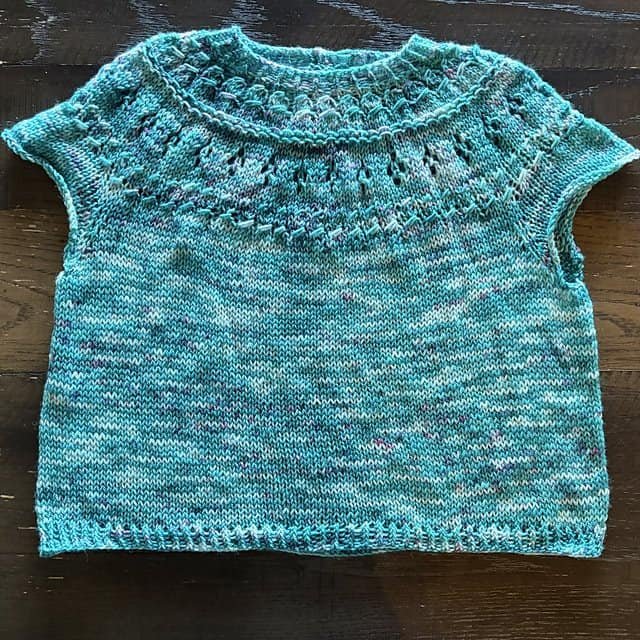
My First Ranunculus: Short Sleeves, Single Skein of Fingering Weight
Yarn: Manos del Uruguay Alegria in Aloha, 100g, 445 yards
My first Ranunculus was a one-skein project, and I’ll be honest: that was the whole appeal. I had a single gorgeous skein of fingering weight yarn and wanted to turn it into something wearable, and a short-sleeved Ranunculus is a great way to do exactly that.
The catch? One skein only gets you so far. The finished sweater is more cropped than I prefer, so it doesn’t get worn as often as I’d like. If I’d had a second skein to add some length to the body, I think I’d love it more (and actually wear it).
The choices I made
- Wide neck. I like a little extra room at the neckline, and the wide option frames the lace yoke nicely.
- Back short rows only. Short rows across the back raise the back of the neck so the front doesn’t ride up toward your throat. I skipped the front short rows on this one.
- Short sleeves. These are worked without putting any stitches on hold, which is a lovely little bit of pattern design that I hadn’t seen before.
What went wrong
I’m pretty sure I messed up some of the lace work in the yoke, so the different motifs aren’t as symmetrical with each other as intended. But once it’s blocked and on a body, you can’t really tell, and nobody else is paying attention to that. It’s still pretty, and I’ve made my peace with it.
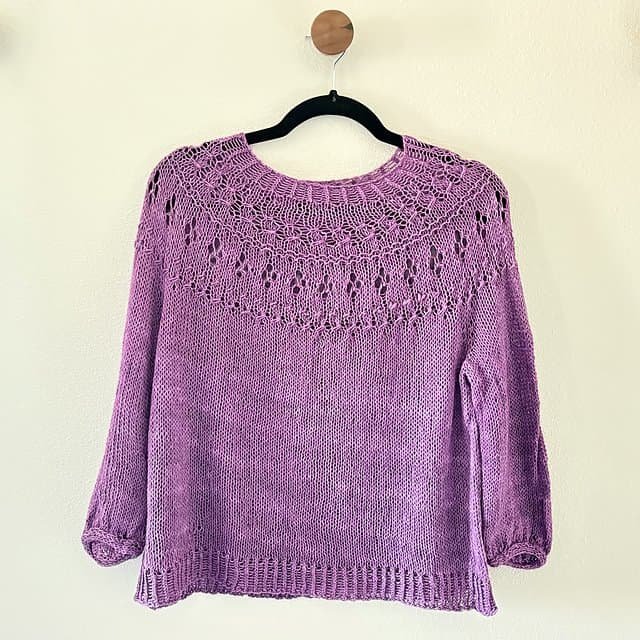
My Second Ranunculus: Long Sleeves, Sport Weight
Yarn: Manos del Uruguay Serena (discontinued) in Boysenberry, 144g, 490 yards
For round two, I went with a sport weight yarn and long sleeves. I knit it at a loose gauge, as the pattern intends, and this is where I learned that yarn weight isn’t the whole story.
Serena is barely thicker than the fingering weight I used for my first Ranunculus, so you’d think it would handle a loose gauge even better. Nope! It’s pushing the limits of how loose this yarn can go. Meanwhile, the Alegria in my first sweater plumped up beautifully after blocking and filled in all that open space.
The difference likely comes down to fiber. Alegria is a merino blend with plenty of bounce, so it blooms into the gaps. Serena is an alpaca and cotton blend, which drapes beautifully but doesn’t spring back the same way, so a loose gauge stays looking loose. Lesson learned.
The choices I made
- Wide neck. Same as last time. I know what I like!
- Front and back short rows. This time I added both because I knew I wouldn’t be playing yarn chicken.
- Long sleeves, with a twist. I added a few inches before starting the diagonal cuff, which turned the sleeves into something closer to a 3/4 length. It’s a small change, but it’s a great example of how easy this pattern makes it to customize.
How it turned out
I plan to wear it when the weather cools down here in Texas. But I might have to wear a cami under it if it’s too see through. I plan to give it a little more steam blocking to see if I can encourage the fiber to plump up a bit more.
What I’d Tell You Before You Cast On
Two sweaters in, here’s what I’d pass along to a friend starting their first Ranunculus:
- Buy more yarn than you think you need. A single skein makes a cute crop top, which is great if you love to rock a crop top. But if you prefer a longer top, plan for extra yarn. Leftover yarn is a much better problem than a too-short sweater.
- Pick your fiber, not just your weight. I knew I was working a loose gauge, but I wanted the fiber to bloom. Drapey fibers like alpaca and cotton bloom less, apparently, so you need to know that going in.
- Use the shared beginning to your advantage. Knit through most of the yoke, block it, measure your gauge, try it on if you can, and only then commit to a size.
- Mark your lace rows. A stitch marker or a lifeline through the yoke makes lace mistakes much easier to catch (and fix) before they’re ten rows behind you.
- Play with the built-in options. Short rows, sleeve length, and neckline are all easy to adjust. It’s the easiest way to make a popular pattern feel like your own and keep a pattern feeling fresh if you make it more than once.
Is the Ranunculus Worth the Hype?
Yes. It’s quick, forgiving, endlessly customizable, and it fits a lot of bodies well. It’s also a great first sweater if you’re comfortable knitting in the round and following simple lace, since the shared beginning takes so much of the guesswork out of sizing. And the pattern includes tutorial videos for EVERY SINGLE TECHNIQUE.
Will I knit a third? Maybe someday.
Have you knit a Ranunculus? I’d love to hear which modifications you chose and what yarn you used.